Wire Rope Sheave Blocks in 2026 are not a universal choice; the right option depends on the lift. A workshop hoist faces different demands from equipment used outdoors or on a marine deck. Rope diameter, rated capacity, groove profile, bearing design, and cheek-plate strength all influence reliable operation. So does the environment. Dust, salt spray, moisture, and repeated shock loading can affect maintenance needs and service life.
This guide compares features buyers can verify instead of relying on broad product claims. It considers load ratings, rope compatibility, materials, bearing performance, lubrication access, inspection points, and manufacturer documentation. A sheave should rotate without binding, and the rope should sit securely in its groove without pinching or excessive side movement. Small details matter. A poorly matched groove may accelerate rope wear, even when the block looks sturdy. Yet specifications alone cannot predict every result. Installation, alignment, working conditions, and regular inspection also matter. That is worth admitting. The best choice is the block whose specifications fit the task and whose condition can be checked over time. The sections ahead explain how to compare options, weigh trade-offs, and look beyond price or appearance. Before buying, confirm requirements with the equipment manufacturer or a qualified lifting professional.
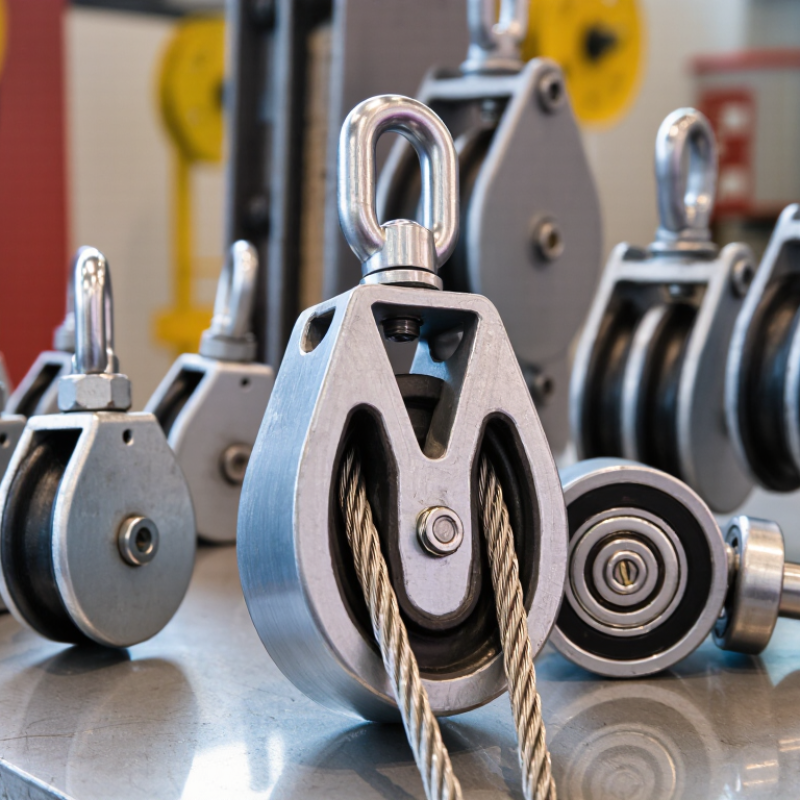
A wire rope sheave block is an assembly that guides a wire rope and redirects its pull. It usually contains a grooved sheave, an axle, side plates, and a connection point such as a hook or eye. The groove supports the rope as it rolls over the wheel. A fixed block changes the direction of force; a moving block travels with the load and can increase mechanical advantage when used with multiple rope parts. Small detail, big consequence: a mismatched groove can accelerate rope wear.
Choosing a block means matching its rated load, rope diameter, and sheave dimensions to the lifting arrangement. The Wire Rope Users Manual, published by the Wire Rope Technical Board, treats sheave-to-rope diameter as a key design relationship, not a one-size-fits-all number. ISO 4309:2017 provides inspection and discard criteria that vary with rope construction and the length examined; it does not support a universal broken-wire limit for every rope. Inspect grooves for sharp edges, check that the sheave turns freely, and look for rope damage near contact points. A clean-looking block can still hide wear. That part is easy to miss.
A wire rope sheave block is an assembly of one or more grooved wheels (sheaves), a frame, and a suspension or attachment point. The rope runs in the grooves to guide its path or form a reeving system. The best choice depends on the load, rope, operating environment, and lifting arrangement.
| Block Type | Typical Configuration | Best-Suited Use | Practical Advantage | Key Selection Checks |
|---|---|---|---|---|
| Single-sheave fixed block | One sheave in a fixed frame, commonly attached to a beam, gantry, or support point. | Changing the direction of a wire rope in a hoist or rigging setup. | Simple rope routing with a compact assembly. By itself, it redirects the rope; it does not provide the same mechanical advantage as a multi-part reeving system. | Confirm the block’s working load limit (WLL), rope diameter range, sheave groove profile, mounting method, and alignment with the rope path. |
| Single-sheave moving block | One sheave suspended from or connected to the load; the rope passes around the sheave. | Basic lifting arrangements where a moving pulley is suitable. | Can provide an ideal mechanical advantage of approximately 2:1 in a simple two-part line, before friction and other losses. | Check the complete reeving arrangement, supporting-line parts, attachment hardware, rope condition, and rated capacity of every component. |
| Double-sheave block | Two sheaves mounted in a common frame; may be used as a fixed or moving block. | Hoisting systems that require multiple rope parts or a more compact reeving layout. | Can support multi-part reeving. The ideal mechanical advantage depends on the number of rope parts supporting the moving block, not simply the number of sheaves. | Verify the reeving diagram, sheave spacing, rope diameter compatibility, block rating, and clearance to prevent rope interference. |
| Multi-sheave block | Three or more sheaves arranged in one or more plates or frames. | Heavier lifting systems designed for multiple-part line reeving. | Allows a greater number of supporting rope parts when the lifting system is designed for that arrangement; added sheaves also add friction and require careful inspection. | Use the manufacturer’s rated configuration and reeving instructions. Check total system capacity, rope fleet angle, lubrication requirements, and sheave and pin condition. |
| Snatch block | A block with a side plate or cheek that opens to admit the rope without threading it from the rope end. | Temporary rigging, winching, or rope redirection where quick installation is useful. | Can be placed on an existing rope run, which may simplify setup. A snatch block is not automatically suitable for every lifting application. | Check side-plate locking, hook or shackle connection, WLL, rope seating, sheave rotation, and whether the block is approved for the intended operation. |
| Sealed-bearing block | Sheave supported by sealed rolling-element bearings. | Applications where reduced routine lubrication or smooth sheave rotation is desired, subject to the design and service conditions. | Sealed bearings can help exclude contaminants and retain lubricant; they still require inspection and have service limits. | Confirm bearing type and maintenance instructions, temperature and environmental limits, rated load, rope compatibility, and signs of damage or rough rotation. |
| Plain-bearing block | Sheave rotates on a plain bearing or bushing around a pin. | Suitable designs for applications where the specified bearing arrangement and maintenance schedule meet operating needs. | Uses a relatively straightforward bearing arrangement. Performance depends on correct lubrication, loading, and maintenance as specified for the block. | Check lubrication intervals, pin and bushing wear, load rating, rope groove condition, and the manufacturer’s operating instructions. |
Safety and sizing note: There is no universally “best” block or single WLL for a block type. Select a block whose marked rating and rope compatibility meet the application, and follow its manufacturer’s instructions and applicable lifting standards. The capacity of a complete system is limited by its weakest rated component; reeving friction, side loading, poor alignment, and damaged rope or hardware can reduce safe performance.
Its grooved wheel redirects the moving rope. In a two-part setup, two rope sections support the moving block, creating an ideal 2:1 mechanical advantage. Real lifting force is higher because friction reduces efficiency.
A small sheave bends the rope more sharply. That can increase bending fatigue and shorten rope life. Bigger is not always better.
A common guideline sets the groove radius at about 0.53–0.55 times the rope diameter. Check the rope specification and use a groove gauge to confirm the fit.
Look for a polished or uneven groove, flattened rope, and broken wires. Check that the rope sits correctly and does not rub against the side plates. Keep inspection records.
A sharp squeal or repeated rope twist deserves attention. Misalignment may be involved, though noise alone cannot identify the problem.
Yes. They can help where dust or moisture enters, but they still need checking. Bearings should turn freely under load, not only by hand.
No. Wear, poor alignment, or an unsuitable groove can shorten rope life despite a high rating. Load capacity is only one part of the fit.
No. Hidden internal damage may not show on the surface. Follow the equipment maker’s inspection procedure and track changes over time. Surface checks have limits.
Wire Rope Sheave Blocks guide wire rope around a wheel to change its direction, support a load, or improve the mechanical advantage of a lifting system. As the rope moves through the grooved sheave, the block helps manage tension and keep the line on its intended path. Available designs can include single- or multiple-sheave blocks, fixed or swiveling attachments, and configurations suited to different rope sizes and working conditions.
The best sheave block for a task is not simply the largest or most complex option. Consider its rated capacity, sheave diameter, groove fit, construction, attachment method, and compatibility with the wire rope and surrounding equipment. The operating environment and frequency of use also matter. Matching these factors to the application can promote smoother rope movement, reduce unnecessary wear, and support dependable performance. Always follow the equipment’s stated limits and inspection guidance.

 MTPM RigParts