A heavy lift is not controlled by crane capacity alone. The rope path, block rating, and rigging arrangement all affect how force moves through a lift. Sheave Blocks guide wire rope around grooved wheels, helping redirect a pull or distribute load across multiple rope parts. More supporting parts can reduce the line pull required, but they also require more rope travel and introduce friction. The setup must match the load.
The stakes are real. The U.S. Bureau of Labor Statistics recorded 5,486 fatal work injuries across all industries in 2022 in its Census of Fatal Occupational Injuries. That figure is not specific to lifting or sheave blocks, so it should not be read as one. It does underline why equipment selection and inspection deserve care. ASME B30.26, Rigging Hardware, provides industry requirements relevant to rigging hardware, including blocks. Operators and riggers should also check the manufacturer’s instructions, rated capacity, rope compatibility, and inspection criteria. Look closely at the groove, bearings, side plates, and attachment points. Wear can be easy to miss.
A rated block is not a guarantee. The complete rigging system must be assessed, and the load’s weight and geometry must be known. In this guide, we examine why Sheave Blocks matter in heavy lifting, how they affect load handling, and what to verify before use. Real lifts are rarely perfect textbook examples. That is exactly why the details matter.
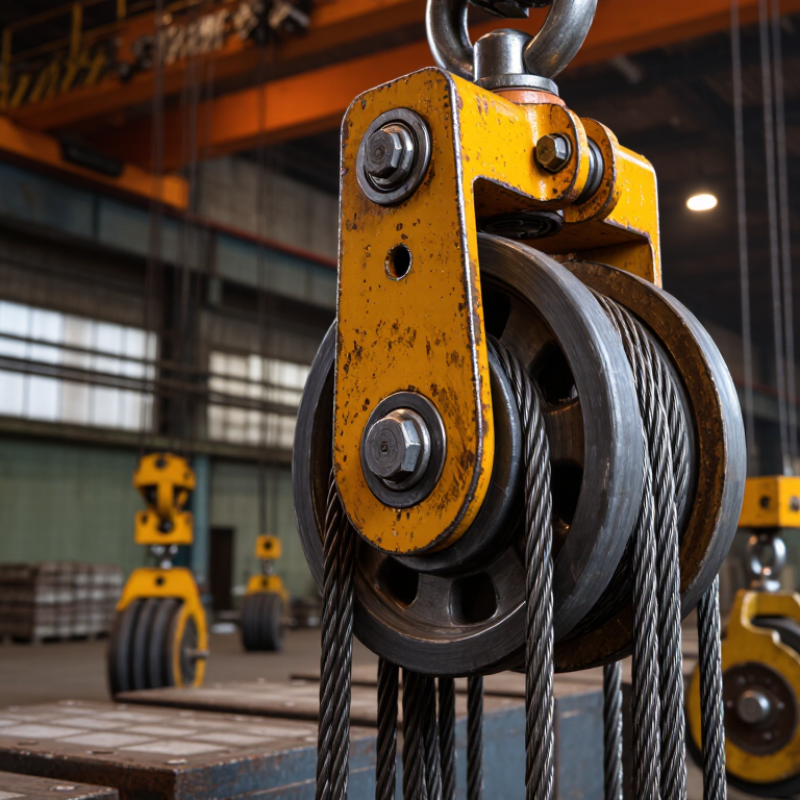
What a Sheave Block Is and How It Works
A sheave block is a housed pulley assembly with one or more grooved wheels, called sheaves. A rope or wire rope runs through the grooves, while a hook or other connection attaches the block to a load or support. The sheave guides the line and reduces rubbing against edges. Bearings inside the wheel help it turn.
How does it multiply lifting force? The rope is reeved through fixed and moving blocks, creating several supporting rope parts beneath the load. With two supporting parts, an ideal system needs about half the load’s force at the pulling end. Real systems need more because friction, rope stiffness, and imperfect alignment reduce efficiency. A fixed block alone changes the pull direction; it does not provide mechanical advantage. Small detail, big difference.
Selection depends on the load, rope size, sheave diameter, and the block’s rated capacity. The U.S. Bureau of Labor Statistics recorded 738 fatal work injuries from contact with objects and equipment in 2022; that figure is not specific to lifting blocks, but it underscores the risks around moving loads. Before use, check for cracks, worn grooves, damaged pins, and a rope that does not sit correctly. A clean-looking block can still be unsafe. The simple diagram rarely shows friction or side loading, so real setups deserve careful review.
Why Are Sheave Blocks Important for Heavy Lifting?
What a Sheave Block Is and How It Works
A sheave block uses grooved wheels (sheaves) to guide a rope and distribute a load across multiple supporting rope parts. This chart shows the ideal pulling force needed to lift a 1,000 kg load as the number of supporting parts increases. More supporting parts reduce the required force, but require more rope to be pulled. Actual pulling force is higher because of friction and other losses.
How Sheave Blocks Change the Direction of a Load
A sheave block redirects a rope’s pull, letting a crew control a load from a safer or more practical position. A fixed sheave changes direction but does not reduce the ideal pulling force. With a moving block, several rope sections support the load. The U.S. Navy training text Basic Machines and How They Work explains this mechanical-advantage principle: two supporting sections create an ideal 2:1 ratio; four create 4:1. Real lifts need more effort because of friction, rope bending, and imperfect alignment. The neat ratio is useful, but it is not the whole story.
On site, the rope should sit properly in the sheave groove, and the block should align with the load. A poor angle can pull sideways and make a steady lift unexpectedly unstable. A sheave changes direction, not danger. Check the block, pins, rope seating, and visible wear before lifting. OSHA’s construction rigging rule, 29 CFR 1926.251(a)(1), requires rigging equipment to be inspected before each shift and as necessary during use. Do not use a pulley ratio to guess a block’s rated capacity; follow its markings and approved load limits. A slow test lift helps reveal problems, though it cannot replace inspection.
How Multiple Sheaves Reduce Lifting Effort
A sheave block reduces the force needed to lift a heavy load by sharing its weight across several supporting rope sections. The key factor is not simply the number of wheels, but how many rope parts support the moving block. In an ideal setup, four supporting parts can reduce the pulling force to roughly one quarter of the load’s weight. Real systems require more force because rope bends over sheaves and friction consumes energy.
That trade-off matters. You pull more rope, but with less effort. If a load rises one metre through a four-part arrangement, about four metres of rope must be hauled in. On a worksite, that extra travel can mean more time and a longer clear area for the rope. Check the block’s rated capacity, the anchor point, and the rope’s condition before lifting; a strong block cannot compensate for a weak attachment. A stiff sheave or badly aligned rope can also increase resistance. One easy detail to overlook is the moving block’s own weight. It adds to the load, and the real pulling effort may be higher than a simple calculation suggests.
Why Are Sheave Blocks Important for Heavy Lifting? - How Multiple Sheaves Reduce Lifting Effort
| Example Reeving Arrangement |
Supporting Rope Parts |
Ideal Mechanical Advantage |
Ideal Pull for a 1,000 kg Load |
Illustrative System Efficiency |
Estimated Pull at Assumed Efficiency |
Rope Travel for 1 m of Load Rise |
| Single fixed sheave; mainly changes the direction of the pull |
1 |
1:1 |
9.81 kN |
95% |
10.33 kN |
About 1 m |
| One movable sheave with a suitable anchor point |
2 |
2:1 |
4.91 kN |
90% |
5.45 kN |
About 2 m |
| Two-part block arrangement reeved for a 4:1 purchase |
4 |
4:1 |
2.45 kN |
85% |
2.89 kN |
About 4 m |
| Block arrangement reeved for a 6:1 purchase |
6 |
6:1 |
1.64 kN |
80% |
2.04 kN |
About 6 m |
| Block arrangement reeved for an 8:1 purchase |
8 |
8:1 |
1.23 kN |
75% |
1.64 kN |
About 8 m |
Values are illustrative, based on a 1,000 kg suspended load (approximately 9.81 kN) and assumed overall efficiencies; actual pulling force varies with sheave bearings, rope condition, alignment, and reeving. More supporting rope parts reduce the ideal input force, but require proportionally more rope travel. Always follow the equipment’s rated capacity and use properly rated blocks, rope, anchors, and rigging.
Key Benefits of Sheave Blocks in Heavy Lifting
Key Benefits of Sheave Blocks in Heavy Lifting
A sheave block changes the direction of a pull and, when reeved into a tackle, can reduce the effort needed to move a heavy load. More supporting rope parts generally mean greater mechanical advantage, though friction and extra rope travel affect real-world performance. That trade-off matters. A carefully rigged block can help crews position a load through a tight space, such as guiding a steel beam past a column, with more controlled movement. The U.S. Bureau of Labor Statistics recorded 1,075 fatal work injuries in construction in 2023. That figure is a reminder that lifting gear supports a safety system; it does not replace planning, trained operators, or load control.
Sheave blocks also help keep rope aligned and reduce abrupt changes in pulling direction. Their benefit depends on matching the block’s rated capacity, sheave diameter, and rope type to the job. A mismatched setup can add friction, wear the rope, or overload components. OSHA’s construction standard, 29 CFR 1926.251, requires rigging equipment to be inspected before use on each shift and as needed during use. Follow the equipment maker’s instructions and applicable site procedures.
Tips: Before lifting, inspect the sheave, pin, side plates, and rope for cracks, deformation, corrosion, or unusual wear. Confirm the reeving path and keep people clear of the suspended load. A block is not magic; even sound gear can be used badly.
Choosing a Sheave Block for a Lifting Task
Choosing a sheave block starts with the wire rope, not the headline capacity. Check the rope’s diameter and construction, the maximum line pull, the number of supporting parts, and the direction of the pull. A block used at an angle can experience forces its simple load rating does not describe. Match the block’s rated capacity to the actual reeving arrangement, and confirm its connection point and hook or shackle fit the rigging. Small details matter.
The Wire Rope Technical Board’s Wire Rope Users Manual gives a sheave-groove radius guideline of about 0.53 to 0.55 times the rope diameter. Use that as a fit check, not a substitute for the rope and block makers’ specifications. A groove that is too tight can pinch the rope; one that is too wide gives poor support. Check the required sheave-to-rope diameter ratio for the rope construction and duty cycle, too. One easy-to-miss detail is clearance: the rope should run freely without rubbing the cheeks. Dirt, corrosion, and worn grooves also change how the block behaves. A neat calculation can miss those conditions, so inspect the actual setup before lifting.
Conclusion
Sheave Blocks are essential tools in heavy lifting because they guide a rope or cable around one or more grooved wheels, helping control how a load is raised or lowered. A single sheave can redirect the pulling force, making it easier to work from a safer or more convenient position. When several sheaves are combined, the rope passes through multiple supporting points, reducing the effort needed to lift a load, though more rope must be pulled.
By changing force direction and improving mechanical advantage, Sheave Blocks can make lifting operations more manageable and controlled. Choosing the right block depends on the load’s weight, the required lifting height, the rope or cable being used, and the working environment. Checking the block’s rated capacity and ensuring it is compatible with the rest of the lifting setup are important steps. A suitable sheave block can support efficient lifting while helping maintain stability and control.

 MTPM RigParts